samedi 15 février 2020

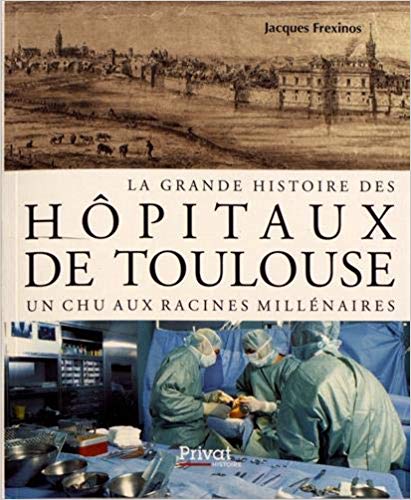
La grande histoire des hôpitaux de Toulouse

La grande histoire des hôpitaux de Toulouse : Un CHU aux racines millénaires 

Jacques Frexinos


Broché : 427 pages
Editeur : Privat; Édition : Reprod. en fac-sim (9 janvier 2020)
Collection : Histoire
Langue : Français
ISBN-13 : 978-2708904064

De par leur taille et leur importance, les hôpitaux font partie des grands chantiers qui rythment la vie des villes. L'échec ou le ralentissement d'une construction pouvait ruiner une municipalité et précipiter le déclin des entrepreneurs. Pendant de nombreux siècles les hospices étaient administrés par des religieux qui formaient l'essentiel du corps soignant; ils ont peu à peu laissé la place à un personnel de plus en plus spécialisé et qualifié. Tout le monde connaît les mythiques hôpitaux de Paris : la Pitié Salpêtrière, les Quinze-Vingts, Sainte Anne... Mais connaissez-vous les hôpitaux de Toulouse et leur histoire ? l'Hôtel-Dieu et sa sauvegarde impossible ? l'hôpital Saint-Raimond, premier hôpital de Toulouse ? ou bien le très attendu hôpital Purpan, devenu le symbole des hôpitaux modernes à la pointe de la technologie. S'appuyant sur des sources historiques très diverses et détaillant chaque étape de l'histoire de la médecine à Toulouse, cet ouvrage répondra à toutes ces questions et vous fera revivre les différentes phases qui ont fait de Toulouse l'un des plus important pôle hospitalier de France.

Les nouveaux horizons pour les musées médicaux

New Horizons for Medical Museums


Call for papers


Deadline 30 April 2020


Rijksmuseum Boerhaave, Leiden / the Netherlands, 23-26 September 2020

Medical museums are always in flux. Collections containing objects related to the history of medicine and health played a role in teaching, research and learning in the broadest sense. From small scale local collections to national medical heritage entities, ways of dealing with these collections continue to change. The topic of this conference is the role of medical museums (collections) in the past, present and future. To explore this topic, an international and interdisciplinary conference will be held at Rijksmuseum Boerhaave in Leiden, the Netherlands between 23 and 26 September 2020. The conference aims to bring curators, scholars, students and medical professionals together to discuss ways of making and keeping medical collections relevant. What could be the place for medical heritage within the new museological landscape? How can we explore new horizons for medical museums?


Papers (20 minutes) might address, but are not limited to the following themes:

● Medical museums and the future

● International collaborations and medical collections

● History of medical museums/collections

● Medical museums and teaching

● New approaches towards exhibiting medical collections

● Audiences old and new - diversity, inclusion and public engagement

● Medical museums and media


We particularly welcome papers or panels that are explicitly inclusive and embed diversity into our discussions.


Proposals for papers should be in a single Word document, including 250-word abstract and a short CV/biographical statement, and sent to mieneketehennepe@rijksmuseumboerhaave.nl by 30 April 2020. We also welcome proposals from participants who would like to present or discuss on a roundtable some of the ways that they are working together on medical collections related topics.


This conference will be organized by a new international association for medical museums (the International Association for Medical Museums (IAMM)). This association is the successor of the European Association of Museums of the History of the Medical Sciences (EAMHMS). During the 2020 conference the new international association will be formally launched and the founding committee invites all interested to be part of this new movement.

vendredi 14 février 2020

L'atteinte physique à Rome et dans le monde romain


L'intégrité du corps en question - Perceptions et représentations de l'atteinte physique à Rome et dans le monde romain 


Caroline Husquin


Presses universitaires de Rennes
Date de parution 06/02/2020 
Collection Histoire 
ISBN 978-2-7535-7827-2 


Si la présence du handicap dans l'histoire peut sembler un invariant, il n'en est pas de même de sa perception. Si l'on se penche sur le corpus de sources qui permettent d'aborder une telle question, on remarque très vite qu'en dehors des restes osseux, que seul le regard d'un spécialiste de paléopathologie peut faire parler, l'historien est confronté à une subjectivité qu'il doit prendre en compte pour traiter un tel sujet. 
Et c'est là, pour une fois, tout leur intérêt car c'est bien d'elle qu'il s'agit : saisir cette subjectivité permet de rendre la perception du handicap et des êtres qui en sont atteints au sein d'une société donnée. Le regard de l'autre est l'élément qui conditionne l'existence d'un individu à Rome dans l'Antiquité, sa capacité à être pleinement un homme, notamment pour un citoyen romain, de sa naissance à sa mort. 
Dès lors, la répugnance de la société romaine pour les atteintes au corps, et donc la perception de ceux qui en sont victimes, semblent être la condition de l'inclusion ou de l'exclusion des citoyens dans le corps social. Cette importance de la perception et du regard de l'autre dans la définition d'un corps social apte à exercer pleinement ses fonctions est, d'ailleurs, bien visible à différentes échelles ; par exemple, en considérant la place fondamentale dans la vie publique qui est accordée à l'éloquence et à la rhétorique. 
La gestuelle, la voix et la capacité à en user constituent des éléments tout à fait primordiaux de l'exercice du " métier de citoyen " à Rome tel qu'il a été défini par Claude Nicolet (Le métier de citoyen dans la Rome républicaine, Gallimard, Paris, 1976). Ceci n'est pas sans incidences, car " l'oeil du spectateur " n'est pas, à Rome et dans les cités de l'Empire, un simple vecteur de préjugés mais peut donner lieu à des définitions juridiques comme celle du " monstre ", avec des répercussions politiques, sociales et religieuses. 
Le but de ce livre est d'étudier, à partir d'un large dépouillement des sources littéraires et de la documentation archéologique, épigraphique, juridique..., et en associant à la fois approche historique et démarche anthropologique, les perceptions et représentations des êtres infirmes à Rome et les évolutions de celles-ci. Il s'agit de dépeindre comment furent considérées et assistées les personnes physiquement atteintes, à Rome et dans le monde romain, au travers de problématiques qui, pour certaines, sont toujours d'une saisissante actualité dans les sociétés contemporaines.

Les femmes de médecins contre la médecine socialisée

“What the Women Can Do:” Doctors’ Wives and the American Medical Association’s Crusade Against Socialized Medicine 

Lecture by Kelly O’Donnell, Thomas Jefferson University

Comment: Oliva Weisser, University of Massachusetts, Boston

Tuesday 18 February
5:15 PM

Massachusetts Historical Society
1154 Boylston St., Boston, MA 02215

In the mid-twentieth century, the American Medical Association opposed attempts to create a national health program in this country, through lobbying and public outreach about the dangers of socialized medicine. Their most powerful weapon in this fight was a less conventional medical instrument: their wives. This paper examines the mobilization of the AMA Woman’s Auxiliary as the main “public relations firm” of organized medicine during these debates and their lingering influence on American health politics.

The Boston Seminar on the History of Women, Gender, & Sexuality invites you to come join the conversation on Tuesday 18 February at 5:15 PM. Discussion is followed by a reception of light refreshments from 6:45-7:30 PM. Our sessions are free and open to everyone. Register to reserve your seat. Subscribers for the current year may now log in to access the paper for this session. All others who register will receive the paper by email the day before the seminar.

Want to receive advanced copies of seminar papers? Become a subscriber!

Questions? Email seminars@masshist.org.

jeudi 13 février 2020

Les bains publics dans l'Antiquité tardive

Public Baths and Bathing Habits in Late Antiquity. A Study of the Evidence from Italy, North Africa and Palestine A.D. 285-700

Sadi Maréchal

Brill
Late Antique Archaeology (Supplementary Series), Volume: 6
Publication Date: 20 Jan 2020
ISBN: 978-90-04-41942-1


In this book Sadi Maréchal examines the survival, transformation and eventual decline of Roman public baths and bathing habits in Italy, North Africa and Palestine during Late Antiquity. Through the analysis of archaeological remains, ancient literature, inscriptions and papyri, the continued importance of bathhouses as social hubs within the urban fabric is demonstrated, thus radically altering common misconceptions of their decline through the rise of Christianity and elite seclusion. Persistent ideas about health and hygiene, as well as perpetuating ideas of civic self-esteem, drove people to build, restore and praise these focal points of daily life when other classical buildings were left to crumble. 


Bourse de recherche Vera Roberts

CAHN-ACHN - Vera Roberts’ Research Award/Bourse de recherche


Call for Applications/ Appel à Candidatures


The Canadian Association for the History of Nursing (CAHN-ACHN) invites applications for the Vera Roberts’ Endowment (VRE). The VRE provides funding to qualified investigators for historical research and publication of topics related to outpost nursing or nursing in remote areas with priority given to circumpolar regions (defined as “North of 60 degrees parallel” for Canada). Eligible applicants include: graduate and post-doctoral students, established researchers in nursing history, and persons with informal experience in historical research.

Application forms are available at http://cahn-achn.ca/awards/ and must be accompanied by a detailed proposal, curriculum vitae, and all other necessary documents. Please refer to the Guidelines for Nursing History Proposals.


Applications must be submitted electronically by March 31, 2020. Questions and completed applications can be sent to Dr. Geertje Boschma, University of British Columbia at geertje.boschma@ubc.ca


Le Fonds Vera Roberts (FVR)

L’Association canadienne pour l’histoire du nursing (CAHN-ACHN) sollicite des candidatures pour Le Fonds Vera Roberts (FVR). Le FVR fournit des subventions à des enquêteures qualifiées* pour leurs recherches et publications en histoire du nursing en régions éloignées au Canada. Une priorité est accordée aux régions circumpolaires canadiennes (c’est à dire celle au nord du 60ième parallèle). Les enquêteures admissibles comprennent: les graduées et celles qui font des études postdoctorales, les chercheures reconnues en histoire du nursing, ainsi que les personnes possédant de l’expérience non-professionelle en recherche de type historique.

Les formulaires de demande sont disponibles à http://cahn-achn.ca/awards et doive être accompagnés d’une proposition de projet détaillée, un curriculum vitae, et tous les autres documents nécessaires. Pour plus d’informations, référez-vous aux “directives de soumissions de projects de recherche en histoire du nursing” inclus dans le formulaire de demande au lien électronique ci-dessus.


Les applications doivent être soumises par voie électronique d’ici le 31er Mars 2020. Adressez vos questions et demandes dûment remplies à Dr. Geertje Boschma, University of British Columbia par courriel à geertje.boschma@ubc.ca


*Dans cette correspondence, le féminin inclut le masculine.

mercredi 12 février 2020

Le sang

Le sang : imaginaires et réalités. Des excès de la saignée à la transfusion sanguine

Philippe Scherpereel 


L'Harmattan
Collection : Médecine à travers les siècles
Date de publication : 5 février 2020


Depuis la préhistoire et la plus haute antiquité, le sang a généré de multiples mythes et fantasmes. L'imaginaire du sang véhicule une double image, celle de la venue au monde et celle de la mort et donc de la vie elle-même et de la métaphysique de l'être. Le sang interroge les anthropologues et tient une place centrale dans les trois religions du Livre. Incroyable aventure médicale, le sang puise ses racines dans l'imaginaire et l'inconscient des hommes.

Femmes et aide humanitaire dans la Grande Guerre

Women, Gender Roles and Humanitarian Aid in the Greater War (1912-1925)

Call for Papers

24-25 June 2020, University Foundation (Brussels)

Keynote Speakers: Prof. dr. Sophie De Schaepdrijver (Pennsylvania State University) and Prof. dr. Susan R. Grayzel (Utah State University) 

CfP deadline: 15 February 2020, abstract (250 words) and short biography (150 words) to womenhumanitarianaid@gmail.com

Female-centred humanitarian aid has gained traction in recent years. In 2016, the UN Population Fund stated that ‘to succeed in building a more stable world, leaders will have to address the needs and protect the rights of affected women and girls, and incorporate their leadership and knowledge into all plans.’[1] In response, humanitarian agencies have launched a number of initiatives that empower girls through education, create cash-for-work programs for women and localise long-term aid in communities through female involvement.

While these issues might seem new and timely, women have shaped humanitarian agendas for more than a century. In the era of World War One, when Europe was also a recipient of help, numerous international aid organisations such as the Commission for Relief in Belgium, the Jewish Joint Distribution Committee, the Rockefeller Foundation, the International Committee of the Red Cross and Save the Children tried to combat poverty, illness and trauma through the education and participation of European girls, women and mothers. The international, national and local civilian aid programs were often carried out by women. Female volunteers (society ladies and nobility members) laboured alongside professionals (home economists, nutritionists, nurses, physicians, social workers and librarians). These relief workers struggled with some of the same challenges humanitarian workers face today: how to reach crisis-affected civilians and particularly women in the private sphere of the home? How, when and where are traditional gender roles maintained, reinforced or disrupted by helping women and employing female humanitarian workers? How to push forward, fundraise for and carry out female oriented humanitarian projects in male dominated organisations and societies?

The two-day conference Women, Gender Roles and Humanitarian Aid in the Greater War will examine these and other questions by looking at the specific humanitarian programs for women and girls in Europe during and after the First World War. We look for contributions that analyse the nature of the programs by and/or for women and girls - both internationally and locally. We especially welcome presentations that go beyond Western Europe. It is envisaged that a selection of conference papers will be published in a special issue. 

Presenters are invited to talk about, but should not feel limited to:
The different goals and approaches of humanitarian initiatives aimed at and carried out by female actors as compared to other civilian aid initiatives; with special attention to collaborations or tensions between humanitarians and recipients
The negotiation of specific gender roles, the responsibilities and expectations of the local women and girls involved
The involvement of feminist and/or conservative women’s movements in international aid
The relationship between female humanitarians/isms and social reforms; and the tension between the domestic focus of much of this humanitarian work and its political implications
The (assessment of) the specific needs and rights of crisis-affected women and girls in European countries during and after the war, including the policies towards national minorities
The mobilization of traditional activities of women including cooking, child-care, sewing and lacemaking
The role of working female professionals, such as physicians, educators, nutritionists and social workers in designing aid programs
Female health: the involvement of mothers and teachers in child-centred aid, reproductive health and eugenics, and the treatment of rape and other forms of sexual violence
The larger goals on a personal/organisational, gender, economic or political level of the humanitarian actors and organisations and the impact of these programs on a short- and long-term basis

Researchers and humanitarian professionals interested in presenting a 20-minute paper at the conference are invited to send a brief abstract of 250 words and a short biography of 150 words by 15 February 2020 to womenhumanitarianaid@gmail.com. Invitations will be sent out by mid-March 2020.

Important note: early career researchers may be eligible for small travel grants. Should you wish to apply for funding, please attach a budget and a short rationale for the funding request to your abstract and biography.

---

Keynote Speakers

Prof. dr. Sophie De Schaepdrijver (Pennsylvania State University)

Prof. dr. Susan R. Grayzel (Utah State University) 


Organising Committee

Prof. dr. Nel de Mûelenaere, Vrije Universiteit Brussel (FOST) 

Dr. Wendy Wiertz, KU Leuven | academic visitor Oxford Centre for European History

Prof. dr. Antoon Vrints, Ghent University


Scientific Committee

Prof. dr. Kenneth Bertrams (Université Libre de Bruxelles), Prof. dr. Bruno Cabanes (Ohio State University), Prof. dr. Henk de Smaele (Universiteit Antwerpen), Dr. Rebecca Gill (Huddersfield University), Dr. Jaclyn Granick (Cardiff University), Prof. dr. David Hopkin (University of Oxford, Hertford College), Prof. dr. Julia F. Irwin (University of South Florida), Dr. Francesca Piana (Université de Genève), Dr. Elisabeth Piller (University College Dublin), Prof. dr. Pierre Purseigle (University of Warwick), Prof. dr. Kaat Wils (KU Leuven)


[1] 10 things you should know about women & the world’s humanitarian crises, United Nations Population Fund, 23 May 2016. https://www.unfpa.org/news/10-things-you-should-know-about-women-world%E...

Contact Info: 


Nel de Mûelenaere, Vrije Universiteit Brussel (FOST) - nel.de.muelenaere@vub.be

Wendy Wiertz, KU Leuven | academic visitor Oxford Centre for European History - wendy.wiertz@kuleuven.be

Antoon Vrints, Ghent University - antoon.vrints@ugent.be
Contact Email: