mardi 26 mars 2013

Autorité dans les sciences médicales


We are seeking contributors to a session at the 2013 History of Science Society meeting, to be held this November in Boston, MA. If you think that your work resonates with the summary below and you are interested in getting involved, please send an abstract to Sean Cohmer (scohmer@asu.edu). Thanks!


"Authority in the Medical Sciences: Evolution of Disciplinary Practices in the Mid-20th Century

This panel will focus on historical moments in the mid-20th century during which practices in the medical sciences experience dramatic change. Specifically, how scientific theories of causation and attitudes of responsibility in society bring about such changes. Biomedicine at this time is characterized by a rise in the use of statistics and epidemiology, creation of new patient and professional group identities, and the emergence of therapeutic and regulatory standards, which dramatically altered the medical landscape.

Papers should discuss changing practices in either the clinic or clinical definitions of disease or disorder, particularly as it relates to an historical shift in medical authority. For instance, one paper will focus on how changing views of autism’s etiology in the 1960s served a catalytic role in the reformation of the third revision of the diagnostic and statistical manual of mental disorders (DSM-III).

Sean Cohmer & Erica O’Neil (Center for Biology and Society, Arizona State University)

If you are interested in participating in this session, please send an abstract to Sean Cohmer,  (scohmer@asu.edu) by March 27th."

lundi 25 mars 2013

Esprits mélancoliques et corps douloureux

Melancholy Minds and Painful Bodies
Genealogy, Geography, Pathogeny

University of Liverpool, 9-11 July 2013


One of the major developments in the study of melancholia over the last thirty years has been the rise to aesthetic and cultural prominence of varieties of negative emotions proposed and discussed as melancholy, including different conceptions, analyses, and portrayals from grief to insanity. Most recently, Lars von Trier’s film Melancholia (2011) happens to be the melodramatic adaptation of the concept fuelled by cinematic symbols. Correspondingly, often observed as ‘a central European discourse’, melancholia has resurfaced to embody complementary or paradoxical notions not merely in the literary analysis of texts and contexts, but it has also emerged to retrieve its historical categorization. The cultural and social history of emotions entwined with modern medical and psychiatric lexicalization has opened new pathways to provide relative definitions of melancholia. However, theories about the choice of analogies for melancholy, whether aesthetic, cinematic, religious, or medical, somehow fail to distinguish the connections between contrary factors involved in melancholia.

It is also noteworthy that theories of characterization, no matter of what kind, tend to reformulate and evaluate contrary factors for the sake of preserving ‘superiority’ according to prevalent taste at each moment in time. In Britain, for example, individual and collective melancholia has been appreciated as a sign of genius and national pride at one time and announced as a national malady at another. Analogous is the contemporary history of behavioural rather than cognitive attributes to grief, e.g. tearfulness. Pain, in comparison, is bodily and often mental distress which in the past was closely perceived in relation to melancholia, but today research on pain is divorced from depression let alone melancholy. Thus, we miss the ‘melancholy-pain bridge’ in contemporary scholarship of mental and physical suffering. On the other hand, while pain is seen through the lens of universality, with management models stretching from Chinese medicine to Latin America, melancholia has rarely been investigated beyond the Western borders with regard to its genealogy, pathology, pathogeny, and management. Whether this geographical focus is a matter of re-establishing pre-eminence or in want of psycholinguistic reference, thereby centred on a gap in universal scientific communication, it invites intriguing and challenging enquiries.

We welcome contributions from different fields in humanities, social and life sciences in the following categories and other relevant areas:

  • Diversity in the geography of melancholia and pain
  • The relationship between Western theories of emotions and Oriental conceptions
  • The European hypothesis of melancholia-pain in non-European cultures
  • Orientalism, grief, and abstinence
  • Emotionality as negativity
  • Gender attributes and tearfulness
  • Art history, muscle tension, and the painful posture
  • Interpretation, assumption, semantic relation
  • Fear, Pain, and melancholy dominance
  • Depression and pain
  • Paranoia, melancholia, and pain
  • Misconceptions; cyclothymia and bipolar disorder
  • Melancholy appropriation, ethnicity, multicultural perspectives
  • Cosmology and elegiac pain management
  • Cinematic symbols
  • Literary emotionality, fictive superiority
  • Embodied cognition
  • Anaesthetics, the relationship between medical management and other models
  • Lyric manifestation of melancholy and pain


Submission:

Abstracts and panel proposals of up to 300 words per 20-minute papers are welcome plus a short biographical note. If you wish to attend without presenting a paper, please email the organisers with your CV and a statement as to how your research relates to the conference. Postgraduate students can apply for Dr Wasfia Mhabak Memorial Grantby sending your abstract, 1000-word research statement, and CV to the conference board.

A selection of papers expanded and edited after the conference will be considered for publication in the International Journal of Literature and Psychology (issues 2014). Further particulars: http://embodiments.liv.ac.uk

Initial submission deadline of 1 March is now extended until 30 April 2013.

Email your proposal to: painpara@liv.ac.uk

L'histoire et les sens


2013 Hagley Fellows Conference

“Ways of Knowing the World: History and the Senses”

Saturday April 20, 2013, Hagley Museum and Library, Wilmington, DE

On Saturday April 20, 2013, the Hagley Museum and Library will host, “Ways of Knowing the World: History and the Senses,” a conference sponsored by the Hagley Fellows of the University of Delaware.

The conference will bring together a diverse group of scholars and the public to explore the historical and cultural role of sensory perception in the human experience—including those that look beyond the Aristotelian conception of the five senses.


Mark Smith, Carolina Distinguished Professor of History, University of South Carolina, will deliver the keynote address. He will discuss his new work on sensory history and the American Civil War.

Program

INDUSTRY AND THE SENSES (9:00 am-11:00 am)
Nadia Berenstein (University of Pennsylvania), “Tasting Success: Training for a Job in Flavors, 1954-1984”
Gerard J. Fitzgerald (George Mason University), “‘Lots of folks nearly drove ‘em crazy…’ Soundscapes, Sensory Experience, and the Lives of Southern Mill Hands, 1915-1940”
Anna Thompson Hajdik (University of Wisconsin, Whitewater), “Stock Yard Panoramas and Superlative Spectacles of Animal Disassembly: Chicago’s Packing House Tourism at the Turn of the 20th Century”

EXTRA-SENSORY PERCEPTIONS (11:00 am-1:00 pm)
Alicia Puglionesi (John’s Hopkins University), “The Astonishment of Experiment: Negotiating the Extra-Sensory in Early-Twentieth-Century America”
Richard Steven Nash (John’s Hopkins University), “Bat Bombs and Interphones: Donald Redfield Griffin’s Research during World War II” 
Matthias Klestil, “In the Eyes of the Slaves: On the Visual Regimes and Rhetorics of the Antebellum Slave Narrative”

DESIGNING SENSORY EXPERIENCE (2:00 pm-4:00 pm)
Jeremy Blatter (Harvard University) and Lee Vinsel (Stevens Institute of Technology) , “Light, Signal, and Semaphore: Psychology, Senses, and Safety in the Age of Mechanical Transportation”
Sarah Tracy (University of Toronto), “Democratizing Delicious? MSG and Post-Humanist Rumination on Taste”
Paul Gansky (University of Texas, Austin), “Palpable Privacy: Telephony and Sensory Regulations in Public”

KEYNOTE ADDRESS (4:00 pm-5:00 pm)
Mark Smith, Carolina Distinguished Professor of History, University of South Carolina

To register, please visit our website:

If you have any questions, please contact Hagley Fellows ( hagley.fellows@gmail.com).

Physiologie et pathologie sexuelle dans le Panckoucke

Séminaire du Centre Alexandre Koyré
Psychologie, psychiatrie, psychanalyse: histoires croisées


Physiologie et pathologie sexuelle dans le Dictionnaire des sciences médicales de Panckoucke

Conférence de Juan Rigoli, professeur ordinaire à l'Université de Genève, invité à l'EHESS :

Vendredi 29 mars, de 14h à 16h, Centre Koyré, 27 rue Damesme 75013 Paris, 5e étage.

dimanche 24 mars 2013

Environnement, Maladie, Thérapie


 Séminaire 
Environnement, Maladie, Thérapie

Le séminaire "Environnement, maladie, thérapie" réunit des historiens et des philosophes des sciences qui étudient, de manière transversale et diachronique, les manières dont les hommes se sont représenté la nature, les paysages, et plus généralement, l’environnement. Ils étudient également comment ces représentations ont joué dans la conception des maladies, dans l’histoire des traitements et de la prévention, ainsi que dans la restructuration de leur environnement. 
Dans l’objectif de réfléchir ainsi aux liens que l’homme entretient avec son environnement, certaines pistes seront explorées dès cette année : nous nous proposons de réfléchir à ce que sous-tendent les idées de nature, d’environnement, dans des contextes très différents (Chine, Vietnam, Afrique, Monde Arabo-Musulman, Europe et Amérique latine) à des époques variées. Nous chercherons à dégager comment, dans chacun de ces contextes, l’environnement peut être perçu comme générateur de ressources hostiles ou bénéfiques à l’homme (brumes miasmatiques, odeurs pathogènes, mais aussi source d’élixirs de longévité ou écosystème parfait) ; comment il peut être conçu comme à l’origine de corporalités différentes, sujettes à des pathologies spécifiques, appelant en retour des thérapies particulières ou des aménagements de l’espace ; et comment l’homme s’emploie à en extraire les bienfaits ou à en éradiquer l’hostilité réelle ou présumée.aura lieu le vendredi 29 mars , de 9h30 à12h, en salle Klein, 612B, du Bâtiment Condorcet, Université Paris Diderot.


29 mars 2013 !! attention, exceptionnellement salle Klein-612B !!

Emmanuel Poisson
Les miasmes comme instrument de régulation bureaucratique au Viêt Nam (XVe-XIXe s.)

Florence Bretelle-Establet
Brouillards miasmatiques, odeurs pathogènes : environnement et maladie dans l’extrême sud de la Chine


19 avril

Valérie Chansigaud
« Fuir la ville et se purifier dans la nature » : la construction d’une nature source de santé physique et mentale (1850-1930)


Lucia Candelise
L’homme et l’Environnement dans le discours des médecins du 20e siècle qui diffusent la médecine chinoise en France et en Europe


24 mai

Merhnaz Katouzian-Safadi
Diversités géographiques, variétés thérapeutiques : soins par les argiles, examen des textes pharmaceutiques médiévaux

Joelle Ricordel
Diversités climatiques et de terroir : Les médicaments simples utilisés dans Al-Andalus mais non mentionnés par Dioscoride


7 juin

Anne-Marie Moulin
Distinguer ce qui est médical et ce qui ne l’est pas : histoire comparée des soins infirmiers (France, Moyen-Orient)

Anne-Lyse Chabert
« Des « handicaps » générant des prises différentes de la moyenne des gens sur l’environnement spatial de façon inter- et intra-individuelles Ou Sens éthique de l’accessibilité et de la construction : l’environnement comme thérapie, ou au contraire comme continuateur de la pathologie

Diffusion de l’hygiène publique

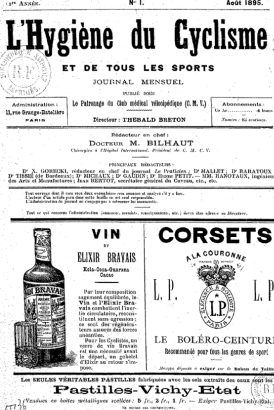
Hygiène du cyclismeSuite du cycle de conférences en histoire de la médecine et de la santé publique (du XVIIIe au XXe siècles) à la faculté de médecine Paris Descartes.

La troisième conférence aura lieu le jeudi 28 mars 2013, de 18h à 20h.
(au 15, rue de l’École-de-Médecine, attention aux accès perturbés par les travaux !)

« Histoire de la diffusion de l’hygiène publique et de la médecine au XIX et au XXe siècles »


Deux interventions sont prévues :

« Périodiques d’hygiène publique et privée conservés à la BnF, essai de réflexion.» Par Anne Boyer chargée d’inventaire rétrospectif à la bibliothèque nationale de France (Département Sciences et techniques).


« La Société Française d’Histoire de la médecine aujourd’hui (fondée en 1902). » Par le docteur en médecine Pierre Thillaud, président de la SFHM.


Ces conférences-débats s’adressent aux professionnels de santé, universitaires, étudiants, curieux… et se veulent un temps de rencontres et d’échanges entre les participants et les chercheurs en sciences humaines et en médecine spécialistes de l’histoire de ces questions.
Au 15, rue de l’École-de-Médecine (côté Cordeliers), 75005 Paris, amphithéâtre Portier, 2e étage (ascenseur pour les personnes à mobilité réduite).
Métros Cluny-La Sorbonne, Saint-Michel, Odéon.

les thérapeutiques naturelles

Technologies of Natural Therapeutics
CFP SHOT Panel


We are seeking an additional panelist and chair for SHOT 2013.  The panel will focus on devices and movements that have tried to create technological substitutes for, or variations of, what medical historians might consider "natural therapeutics"--aspects of the environment that people have believed foster and improve human health.  One paper will explore the discovery of ozone, beliefs about its therapeutic benefits, and the development/use of ozone generators, while the other examines the interconnections between beliefs about sunlight, UV lamps, and health as they were applied to children's bodies.  While these papers focus on the late 19th and early 20th centuries, we welcome extending our discussion over a wider time period.

If interested, please send a brief abstract of your paper to Melanie Kiechle (mkiechle@vt.edu) and Meghan Crnic (crnic@sas.upenn.edu) by Wednesday, March 27.  SHOT proposals are due March 31.

samedi 23 mars 2013

Les organisations internationales de santé et l'histoire

IHOs and the history of health and medicine
Call for Papers

A jointly organised conference between the Shanghai Social Sciences Association, the David Musto Centre at Shanghai University, and the CSHHH Glasgow at the University of Strathclyde

Proposals for panels and papers of no more than 300 words per paper are welcomed by April 30th 2013. Please submit by email to zhangyongan@shu.edu.cn and zhouqish@126.com. Those accepted will be notified by May 16 2013.

IHOs and the history of health and medicine

Recent studies of institutions as varied as the League of Nations Health Committee, the Rockefeller Foundation and the Medical Missionary Society have drawn attention to the multiple roles played by international organisations since the nineteenth-century in the fields of healthcare and medicine. Most obviously they have played important parts in addressing particular health crises and emergencies, by providing medical expertise, drugs and medicines, and more general aid. Longer term impacts, however, have included the establishment of lasting healthcare infrastructures, the dissemination of new ideas about health and medicine, and the emergence of major bodies that transcend national political, economic and professional interests. However, from the refusal of the East India Company to sanction medical missionary activity in the eighteenth-century, to the recent ban on the WHO by al-Shabaab in Somalia, such international organisations have often faced opposition and hostility.

While there are a number of studies of particular institutions and movements, the IHO has rarely been viewed as a distinct phenomenon in the history of health and medicine in the modern period. This conference seeks to address this by bringing together historians and those from related disciplines with relevant research interests. It aims to examine fresh insights into particular periods, organisations and case studies, but also to explore the potential of comparative perspectives, and of teasing IHOs out of the wider history of health and medicine in modernity.

Key questions would include:

  • What agendas and ideologies shaped the emergence of IHOs in the nineteenth and twentieth centuries?
  • How far have IHOs met their objectives and what shaped or prevented success?
  • What impacts have IHOs had in the locales where they have been embedded?
  • To what extent have locals worked with or against IHOs and what shaped their approaches?
  • In what ways has the emergence of the IHO had wider impacts on international relations, and on domestic relations in contributing countries and cultures?
  • What does the emergence of the IHO over the last two centuries tell historians about the history of medicine, and of modernity?


Organisation and Arrangements

The organisers are keen to consider all relevant institutions, contexts and perspectives in order to stimulate an inclusive event. Proposals for panels and papers of no more than 300 words per paper are welcomed by April 30th 2013. Please submit by email to zhangyongan@shu.edu.cn and zhouqish@126.com.

Those accepted will be notified by May 16 2013. Participation will require the submission of papers of no more than 5000 words by September 30 2013. The intention is to publish a collected edition of papers from the event. The conference will take place in Baoshan Campus at Shanghai University, Shanghai and accommodation will be provided for all participants. Some funding for travel may be available to post-graduate students and early career scholars.