dimanche 23 septembre 2012

Accidents et urgences

Accidents and Emergencies: 

Risk, Welfare and Safety in Europe and North America, c. 1750-2000


Keynote speakers
Professor Bill Luckin (University of Bolton, UK)
Dr Arwen Mohun (University of Delaware, USA)

Context and aims

We live in a society obsessed with risk and safety. Via a medley of state-related and commercial agencies, we insure ourselves against the possibility of death, ill-health, accident, theft and unemployment, subjecting every facet of our lives to the calculus of risk. Meanwhile, a battery of signs, leaflets, manuals and adverts spread the message of ‘health and safety’, reminding us of the dangers lurking in our everyday actions.
Equally, notions of risk and safety go to the heart of our sense of collective welfare, and the complex relations of self, society and the State, and public and private agency. Indeed, for some sociologists, we live in a ‘risk society’, premised on the ‘reflexive’ processing of information, the prevention of the accidental and the unexpected, and the anxious desire to predict – even control – the future.

The aim of this conference is to take stock of the present by focussing on modern Europe and North America from roughly 1750 onwards. It welcomes:
 historians from all sub-fields (social, medical, cultural, etc.)
 scholars from other disciplines such as sociology and cultural studies.
Risk, welfare and safety have long been sites of historical inquiry. This conference takes this literature as its point of departure, and encourages both general and trans-national appraisals of the history and nature of modern ‘risk societies’, as well as accounts which focus on particular technologies, practices and discourses.

In sum, the aim of ‘Accidents and Emergencies’ is to:
- rethink the history of risk, welfare and safety;
- encourage a more integrated approach to their empirical study and conceptualisation;
- open up new historical and sociological perspectives through which we might better grasp the present.

Format and themes

This will be a three-day conference: 9, 10 & 11 September 2013, to be held at Oxford Brookes University and supported by the University of Portsmouth.

We intend that the papers should be pre-circulated, in a draft form of around 5,000 words (though we appreciate this will not be possible in all cases).

Papers – conceptual and empirical – are invited which address one or more of the following themes:

1. Conceptualising and historicising ‘risk society’: the work of Beck, Giddens, Luhmann and Ewald – and others
2. The politics of risk and solidarity: liberalism, social democracy and neo-liberalism
3. Selling risk and safety: mixed economies of welfare, and the insurance and safety industries
4. Statistics, temporality and the calculus of risk: histories of actuarial probability
5. Industrial risks (i): pollution and the environment
6. Industrial risks (ii): technology and workplace accidents
7. Shock, trauma and sensation: representing accidents and emergencies
8. Logistics of risk and safety: emergency services and technologies
9. Preventing accidents (i): surveillance, inspection and maintenance
10. Preventing accidents (ii): health and safety education
11. Transnational risks and exchanges: policies, innovations and institutions
12. Key words: meanings of ‘safety’, ‘risk’, ‘probability’ and ‘accident’ in particular contexts
Over the three days we would like speakers to raise the salient issues of their papers in order to leave as much time as possible for discussion and feedback. The conference language will be English.
We intend to publish a selection of the papers in the form of an edited volume or special issue of a journal.

Contacts

Expressions of interest to: mike.esbester@port.ac.uk.

These should include:

- a brief ‘bio’ (detailing institution, publications, research interests, etc.)
- a proposal/abstract (of roughly 300 words), indicating the theme or themes for which you wish to be considered.

The deadline for the submission of abstracts is 31 January 2013.
Alternatively, if you are interested in attending as a delegate please email to reserve a place.
Conference organisation enquiries: tcrook@brookes.ac.uk
Organisers: Dr Tom Crook (Oxford Brookes University) and Dr Mike Esbester (University of Portsmouth).

samedi 22 septembre 2012

Exposition sur la dissection

Doctors, Dissection and Resurrection Men

19 October 2012 – 14 April 2013


In 2006, archaeologists from the Museum of London excavated a burial ground at the Royal London Hospital in Whitechapel. What they found was both extraordinary and unexpected.

The excavation revealed some 262 burials. In the confusing mix of bones was extensive evidence of dissection, autopsy, amputation, bones wired for teaching, and animals dissected for comparative anatomy. 

Dating from a key period – that of the Anatomy Act of 1832 – the discovery is one of the most significant in the UK, offering fresh insight into early 19th century dissection and the trade in dead bodies. Passed amid deep public fear following a notorious case of murder for dissection, this fiercely-debated Act gave the State the right to take ‘unclaimed’ bodies without consent, and remained almost entirely unchanged until the Human Tissue Act of 2004.

Now, 180 years later, you can uncover this intriguing story in Doctors, Dissection and Resurrection Men, a major new exhibition at the Museum of London. Bringing together human and animal remains, exquisite anatomical models and drawings, documents and original artefacts, the exhibition will reveal the intimate relationship between surgeons pushing forward anatomical study and the ‘Resurrection men’ who supplied them; and the shadowy practices prompted by a growing demand for corpses.

You’ll discover the story of Bishop, Williams and May – London’s Burke and Hare – and find out how the excavation findings shed new light on the case of an alleged resurrectionist, who died in prison while his wife protested his innocence. You’ll also pore over unrivalled evidence of surgery and amputation – before anaesthetic – and of dissection, anatomical teaching and students practising their craft. 

As the exhibition draws to a close, you’ll be encouraged to debate the Anatomy Act, reflect on medical ethics and cultural attitudes today, and ask what questions still remain in 2012.

It may leave you asking: who really owns your body?


Tickets

Adult £9

Concession/child (aged 12+) £7

Friends of the Museum FREE

Art Fund members £4.50


Groups of 10 or more people receive a 20% discount when booked in advance on 020 7001 9844.

Flexible family tickets are available at our information desk or on 020 7001 9844.

Entry is FREE for secondary schools and FE/HE groups when booked in advance.

Please note entry is timed so you are advised to pre-book if you are unable to wait for the next available timeslot. Advance booking is also strongly recommended for peak times such as weekends and bank holidays.


Book tickets online (an online booking fee applies) or call 020 7001 9844.


Due to its subject matter, Doctors, Dissection and Resurrection Men is not recommended for children under 12. Please note this exhibition features human skeletal remains.
Expert talks for groups


Why not complement your group's visit to our Doctors, Dissection and Resurrection Men exhibition with a special pre-exhibition talk? Choose from one of our three experts who will each explore a different subject, from how the Museum’s skeletal remains were used to develop the exhibition to the archaeological challenges faced during excavations of the Royal London Hospital.


£9 p/person for groups of 20 or more

£180 flat fee for groups of less than 20 people

Excludes exhibition entry. Subject to availability.

Click here for more information or call 020 7001 9844 to book a group visit and/or talk.


Copyright © Science Museum / Science & Society Picture Library

Bicentenaire de l'hôpital royal d'Edimbourg

Bicentenary of the Royal Edinburgh Hospital

Lecture series, 2012 – 13


The Royal Edinburgh Hospital is celebrating its bicentenary in June 2013.
To commemorate 200 years of pioneering mental health care provision, NHS Lothian, with the support of the Wellcome Trust and the Scottish Government,has commissioned an eight-part lecture series to illuminate aspects of the rich anddiverse history of the hospital from the early 19th century to the present day.


Lecture 1 – Keynote lecture and reception,‘Madness Confined’, 3 October 2012
Council Chamber, City Chambers,City of Edinburgh Council,High Street, Edinburgh EH1 1YJ.
Refreshments 6pm, lecture 6.30pm – 7.30pm.

Andrew Scull, Professor of Sociology and Science Studies, University of California at San Diego, will examine the emergence and the consequences of a new perspective on the management of mental illness at the dawn of the 19th century: rational, humane and, above all, curative, paying particular attention to the contrasts and comparisons between developments in England and Scotland.

Lecture 2 – ‘Sport, Health and the Royal Edinburgh Hospital’, 14 November 2012
Royal College of Physicians of Edinburgh, 9 Queen Street, Edinburgh EH2 1JQ.
Refreshments 6pm, lecture 6.30pm – 7.30pm.

John Burnett, until recently Principal Curator, National Museums of Scotland, will look at the significant role sport played in the life of paying and pauper patients at the Royal Edinburgh Hospital in the second half of the 19th century, at a time when sport itself was growing and developing rapidly.

Lecture 3 – ‘Voices of the Mad: Patients’ Letters from the Royal Edinburgh Hospital, 1873-1908’, 12 December 2012
Royal College of Physicians of Edinburgh, 9 Queen Street, Edinburgh EH2 1JQ.
Refreshments 4pm, lecture 4.30pm – 5.30pm.

Dr Allan Beveridge, Consultant Psychiatrist, Queen Margaret Hospital, Dunfermline, will look at the very rich archive of the Royal Edinburgh Hospital. In particular he will examine the extensive collection of  accounts by patients of their mental struggles and experiences. This lecture focuses on the period between 1873 and 1908 when Thomas Clouston was Superintendent of the hospital. Drawing on over a thousand letters written by patients, it examines the life of inmates and descriptions of their mental worlds.
This lecture will be delivered in collaboration with the Edinburgh History of Medicine Group Seminars.
Bicentenary of the Royal Edinburgh Hospital Lecture series, 2012 – 13


Lecture 4 – ‘The female malady? The troubled relationship between psychiatry and gender’, 13 February 2013
Royal College of Physicians of Edinburgh, 9 Queen Street, Edinburgh EH2 1JQ.
Refreshments 4pm, lecture 4.30pm – 5.30pm.

Dr Gayle Davis, Wellcome Lecturer in the History of Medicine, University of Edinburgh, will explore the relationship between psychiatry and gender over the 19th and 20th centuries, using the Royal Edinburgh Hospital as a case study. The lecture will consider why mental illness has been characterised historically as the ‘female malady’, and will ask how significant gender was to psychiatry.
This lecture will be delivered in collaboration with the Edinburgh History of Medicine Group Seminars.

Lecture 5 – ‘Hungry lions, kangaroos and bruised reeds: patient art at the Royal Edinburgh Hospital in the 19th century’, 13 March 2013

Royal College of Physicians of Edinburgh, 9 Queen Street, Edinburgh EH2 1JQ.
Refreshments 4pm, lecture 4.30pm – 5.30pm.

Dr Maureen Park, Senior Lecturer, Centre for Open Studies, University of Glasgow, will use the archive of the Royal Edinburgh Hospital to examine the reasons why, and the extent to which, drawing was promoted as a ‘therapeutic’ activity in the hospital. The lecture will look at the surviving drawings produced by patients such as William Bartholomew, John Myles and John Willis Mason at the Royal Edinburgh  Hospital, and locate their productivity within the wider context of hospital art. The lecture will be fully illustrated.
This lecture will be delivered in collaboration with the Edinburgh History of Medicine Group Seminars.

Lecture 6 – ‘From electric shocks to virtual reality: the treatment of soldiers after battle’, 10 April 2013
Royal College of Physicians of Edinburgh, 9 Queen Street, Edinburgh EH2 1JQ.
Refreshments 6pm, lecture 6.30pm – 7.30pm.

Professor Chris Freeman, Consultant Psychiatrist and Psychotherapist, Royal Edinburgh Hospital, will discuss the history of psychological treatment for soldiers and veterans from the early 20th century to the present day. The lecture starts with services provided at Craiglockhart by WHR Rivers and his colleagues during World War I and also subsequent developments in the Royal Edinburgh Hospital. It will then discuss more recent changes, including the re-establishment of military psychiatric wards in NHS hospitals throughout the UK. It will conclude with an account of Veterans First Point, a one-stop-shop service in Edinburgh for veterans and their families.

Lecture 7 – ‘Psychiatry and Empire’, 8 May 2013
Royal College of Physicians of Edinburgh, 9 Queen Street, Edinburgh EH2 1JQ.
Refreshments 6pm, lecture 6.30 – 7.30pm.

Dr SP Sashidharan, Consultant Psychiatrist, Mental Health Rights (Scotland), will describe the emergence of colonial and post-colonial psychiatry and the significant role played by Edinburgh psychiatry in the shaping of transcultural psychiatry. The lecture will also consider the appropriateness of psychiatric theory and practice in non-European settings and current tensions in Global Mental Health.

Lecture 8 – ‘The rise and rise of scientific psychiatry in Edinburgh’, 4 June 2013
City Chambers, City of Edinburgh Council, High Street, Edinburgh EH1 1YJ.
Refreshments 5.30pm, lecture 6pm – 7pm.

Stephen Lawrie, Professor of Psychiatry and Neuro-Imaging and Honorary Consultant Psychiatrist, University of Edinburgh, will describe the development of scientific psychiatry in Edinburgh, tracing the academic activity of the Physician Superintendents and latterly the Professors of the University Department of Psychiatry within the Royal Edinburgh Hospital, and including the potential of current research for novel therapeutic directions.

Booking
Tickets are free but must be booked in advance, contact Anne Thomson on 0131 537 6399, apart from lectures 3, 4 and 5, which are available on a first come first served basis. Please note that tickets for certain venues are limited, so book early to avoid disappointment.

Acknowledgements
The support of the following organisations is gratefully acknowledged:
• Wellcome Trust
• The Scottish Government
• The City of Edinburgh Council
• Royal College of Physicians of Edinburgh
• The University of Edinburgh
• Lothian Health Services Archive
Lothian Health Services Archive’s
Royal Edinburgh Hospital
Archive Appeal

For more information about the history of the Royal Edinburgh Hospital, please contact NHS Lothian’s Archive, Lothian Health Services Archive (LHSA).
Please help LHSA preserve the story of the Royal Edinburgh Hospital for future generations by donating to the Archive. LHSA is looking for anything from photos and letters to books and objects, dating from the 18th century to the present day. New accessions will supplement and complement NHS Lothian’s own rich collection relating to the hospital. Email: lhsa@ed.ac.uk; tel: 0131 650 3392; www.lhsa.lib.ed.ac.uk.

Neurologie et psychiatrie

Journée scientifique : vendredi 19 octobre 2012

« Apports réciproques de la neurologie et de la psychiatrie »
Resp. : Céline Lefève/Romain Schneckenburger

Université Paris Diderot 
Bâtiment les Grands Moulins, hall C
Salle Pierre Albouy (6ème étage)
5 rue Thomas Mann, Paris 13e
RER/Métro : Bibliothèque François-Mitterrand
Bus : 89, 62, 64, 325

En 2005, Th. Insel, le directeur de National Institute of Mental Health proposait de définir la psychiatrie comme une "clinical neuroscience". Ce faisant, il s'agissait de gommer la distinction classique entre les troubles cérébraux organiques (objets de la neurologie) et les troubles cérébraux fonctionnels (objets de la psychiatrie). Un tel projet s'appuie sur la révolution épistémologique des trente dernières années où, pour reprendre la célèbre expression d'un historien des sciences américain, la psychiatrie impute la maladie mentale non plus "à la mère" mais "au cerveau". Il est vrai que les sciences du cerveau (prises au sens large) ont profondément modifié la conception de la psychiatrie (ne serait-ce qu’à travers la psycho-pharmacologie) et ont conduit à un rapprochement entre neurologie et psychiatrie qui partagent des préoccupations communes, tant sur le plan théorique (explications neurocognitives de phénomènes cliniquement identiques : dépression, délire, troubles des fonctions supérieures) que sur le plan pratique (utilisation de même molécules : anti-dépresseurs pour soigner les douleurs neurogènes, anti-épileptiques pour les troubles maniaco-dépressifs ; utilisation des mêmes techniques : stimulation cérébrale profonde pour la maladie de Parkinson et les TOC invalidants, imagerie cérébrale). S'agit-il pour autant d'un retour pur et simple à la conception des rapports entre neurologie et psychiatrie tels qu'ils étaient décrits au 19ème siècle, notamment par Griesinger ? Pour ce dernier, neurologie et psychiatrie ne se différenciaient pas par nature mais uniquement par le lien privilégié qu'entretenait la psychiatrie avec deux institutions particulières: le tribunal et l'asile. L'enjeu de cette journée sera donc d'examiner, à travers l'analyse d'exemples précis, l'intrication des discours et des pratiques en neurologie et en psychiatrie ainsi que leur originalité respective.

9 h 15 : Accueil et introduction Céline Lefève/Romain Schneckenburger
Matin :
9 h 30 -10 h 10 : Jean-Noël Missa (Univ. Libre de Bruxelles) : Entre thérapie et amélioration : une approche historique des apports réciproques de la psychiatrie et des neurosciences

10 h 10-10 h 50 : Jean-Christophe Coffin (Centre Alexandre Koyré-Univ. Paris Descartes) : Psychiatrie et neurologie à partir d’Henri Ey (1900-1977)

Pause
11 h 10-11 h 50 : Scott Phelbs (Département Histoire des Sciences-Harvard) : titre provisoire : Asognosie, déni de la maladie et absence d’insight en neurologie et en psychiatrie

Discussion générale
Déjeuner libre
Après-midi :
14 h 15-15 h : Claude-Olivier Doron (SPHERE – Univ. Paris Diderot) : Dégénérescence et dissolution du système nerveux 

15 h -15 h 40 : Sarah Troubé (ENS) : De la neurologie à la psychiatrie : peut-on parler d’un délire propre à la psychose ?

Pause
16 h – 16 h 40 : Baptiste Moutaud (CESAMES-Univ. Paris Descartes) : Une "convergence forcée"? Anthropologie d'une collaboration entre neurologie et psychiatrie en psychochirurgie
16 h 40- 17 h 30 : Conclusion de la journée

vendredi 21 septembre 2012

Histoire du handicap aux Etats-Unis

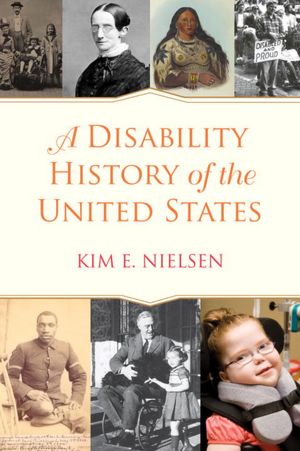
  • A Disability History of the United States


  • Kim E. Nielsen is a professor of history and women’s studies at the University of Wisconsin-Green Bay.

  • Hardcover: 272 pages
  • Éditeur: Beacon Press (2 octobre 2012)
  • Langue: English
  • ISBN-10: 0807022020
  • ISBN-13: 978-0807022023
 
By placing the experiences of people with disabilities at the center of the American story, A Disability History of the United States fundamentally reinterprets how we view our nation’s past. Throughout the book Kim Nielsen illustrates how concepts of disability have deeply shaped the American experience—from deciding who was allowed to immigrate to establishing labor laws and justifying slavery and gender discrimination. The book abounds with compelling stories pulled from primary documents and social histories to retell American history through the eyes, words, and impressions of the people who lived it. Included are absorbing—at times horrific—narratives of blinded slaves being thrown overboard and women being involuntarily sterilized, as well as triumphant accounts of miners organizing strikes and disability rights activists marching on Washington.

Engrossing and revelatory, A Disability History of the United States reconstructs our nation’s story—from a narrow master narrative to a shared history that encompasses us all. As Kim Nielsen writes, disability is “our story, the story of someone we love, the story of whom we may become, and it is undoubtedly the story of our nation.”

Lutte sociale et associative contre la polio

POLICIES, SOCIAL RESPONSES AND ASSOCIATIONIST MOVEMENTS AGAINST POLIOMYELITIS: THE EUROPEAN EXPERIENCE (1940-1975)


DYNAMIS. Acta Hispanica ad Medicinae Scientiarumque Historiam Illustrandam

VOLUMEN 32(2)  2012


DOSSIER

The European fight against the epidemic presence of poliomyelitis: a historical reflection
Rosa Ballester and María Isabel Porras
http://www.revistadynamis.es/images/stories/presentacion_dossier_32_2.pdf


The European Association against Poliomyelitis and the European vaccination programmes
María Isabel Porras, María José Báguena, Rosa Ballester and Jaime de las Heras

The Cutter incident and the development of a Swedish polio vaccine, 1952-1957
Per Axelsson

Polio in Italy Bernardino Fantini

The British Polio Fellowship: its contribution to the development of inclusivity and disabled people Barry North

The social sequelae of polio: the beginnings of the associationist movement in Spain (1957-1975)
Juan Antonio Rodríguez Sánchez

ARTICLES

From the traditional midwife to the female obstetrician. Birth and pinnacle of the profession of licensed midwifery in 19th century Peru Lissell Quiroz

The purge of midwives in Madrid after the Civil War
Dolores Ruiz-Berdún and Alberto Gomis Blanco

IN MEMORIAM

BOOK REVIEWS


jeudi 20 septembre 2012

Le soin dans le passé

Care in the Past: Archaeological and Interdisciplinary Perspectives

 Saturday 6thOctober 2012


Location: Joachim Room, College of St. Hild and St. Bede, Durham University
Registration – 9:00-9:45
Conference Welcome/Introduction – 9:45-10:00
Session 1 – Childhood
10:00-10:20 – Keynote – Mary Lewis (Department of Archaeology, University of Reading) – Child Palaeopathology: Current Status and Future Directions
10:20-10:40 – Jessica Cooney (Department of Archaeology and Anthropology, University of Cambridge) – Palaeolithic Babysitters: Understanding Childcare through the Study of Cave Art
10:40-11:00 – Dawn McLaren (AOC Archaeology) – In Sickness and in Health: Aspects of Early Bronze Age Child Burials in Britain
11:00-11:30 – COFFEE BREAK and Poster Session
11:30-11:50 – Katherine Huntley (Department of History, Boise State University) – Supervision of Young Children in the Roman world
11:50-12:10 – Heidi Dawson (Department of Archaeology and Anthropology, University of Bristol) – Examining Perceptions of Status and Care of the Young in Late Medieval England and how they relate to Skeletal Markers of Stress and Diet
12:10-12:30 – Hannah Newton (Department of History and Philosophy of Science, University of Cambridge) – ‘With Great Care and Paines’: Tending the Sick Child in Early Modern England, 1580-1720
12:30-12:45 – Discussion
12:45-13:45 – LUNCH BREAK
Session 2 – Disability
13:45-14:05 – Keynote - Irina Metzler (Independent Researcher) - Disability and Charity in the Middle Ages
14:05-14:25 – Nick Thorpe (Department of Archaeology, University of Winchester) - The Palaeolithic Compassion Debate - Alternative Projections of Modern-Day Disability into the Distant Past
14:25-14:45 – Veronique Thouroude (Wadham Collage, University of Oxford) - "Care in Britain’s Earliest Hospitals
14:45-15:00 – Discussion
15:00-15:30 – Coffee Break
Session 3 – Treatment and Care
15:30-15:50 – Keynote – Rebecca Gowland (Department of Archaeology, Durham University) - ‘That Tattered Coat upon a Stick, the Ageing Body’: a Bioarchaeological Approach to the Invisible Elderly in Roman Britain.
15:50-16:10 – Marlo Willows (School of History, Classics, and Archaeology, University of Edinburgh) – The Treatment of the Sick at the Isle of May
16:10-16:30 – Gary King (Department of Archaeology, University of Durham) – Rare Secrets of the Physicke: the Role of Insects in Historical Remedies and Treatment
16:30-16:50 – Bryn James (Department of Archaeology, University of Manchester) – ‘Spirit of the Plant’: The Ethnopharmacopoeia of Traditional Healers in Madina, Accra
16:50-17:00 – Discussion
17:00-18:00 – Wine Reception
19:00 onwards – Conference Dinner (details TBC)

Séminaire Histoire de la médecine chinoise

Séminaire Histoire des sciences, des techniques et de la médecine en Asie orientale

 Organisé par Caroline Bodolec (CNRS, UMR 8173),
Catherine Jami (CNRS, UMR 7219) et Frédéric Obringer (CNRS, UMR 8173)
  
Ce séminaire se veut un lieu de présentation de leurs travaux en cours par des chercheurs travaillant sur l’histoire des sciences, des techniques et de la médecine en Asie orientale, région où le chinois classique a longtemps été le principal véhicule des savoirs d’élite. Il s’adresse aux chercheurs et étudiants spécialistes de l’Asie ou historiens des sciences, des techniques et de la médecine. Nous nous y intéresserons autant aux savoirs « traditionnels » de la Chine impériale et de ses voisins qu’aux périodes moderne et contemporaine. 

Le séminaire a lieu, sauf précision contraire, un mardi par mois de 14h à 16h
Salle 646A-Mondrian, Bâtiment Condorcet, Université Paris Diderot
4 rue Elsa Morante, 75013 Paris
  
Mardi 9 octobre 2012 à 14h30
Présentation du séminaire (C. Bodolec, C. Jami et F. Obringer)

Lundi 26-mercredi 28 novembre 2012,
Colloque international, dans le cadre du projet ICCM (ANR-09-SSOC-004)

Mardi 8 janvier 2013 de 9h30 à 17h30
Journée d’étude organisée avec le concours de la D. Kim Foundation, consacrée à la présentation de travaux de jeunes chercheurs sur « Sciences, techniques et médecine en Asie orientale 1850-2000 : travaux de jeunes chercheurs » (le programme détaillé sera publié ultérieurement)

Mardi 12 février 2013
Georges Métailié (CNRS, Paris), A propos des points de jonction et de fusion chez Joseph Needham. Le cas des savoirs botaniques en Chine et en Europe

Mardi 19 mars 2013 (sous réserve)
Marc Kalinowski (EPHE, Paris), Écologie politique et sciences traditionnelles dans la Chine des Royaumes combattants et des Han

Mardi 9 avril 2013
Tomoko Kitagawa (Harvard University & Needham Research Institute), The History of Mathematics in Kyoto: The Quest for “Unalterable Treatises” since 1620

Mardi 14 mai 2013 (date sous réserve)
Françoise Sabban (EHESS, Paris), À la croisée des temps : les techniques de transformation alimentaires dans le traité d'agriculture Qimin yaoshu (VIe siècle ap. J.-C.)

Mardi 11 juin 2013
Catherine Despeux (INALCO), L’influence de la médecine ayurvédique : à propos des techniques thérapeutiques de la Chine des Tang

Informations complémentaires et mises à jour éventuelles :