jeudi 23 mai 2024

Borderline

Borderline: The Biography of a Personality Disorder 


Alexander Kriss


Publisher ‏ : ‎ Beacon Press (April 30, 2024)
Language ‏ : ‎ English
Hardcover ‏ : ‎ 304 pages
ISBN-13 ‏ : ‎ 978-0807007815


An intimate, compassionate, and expansive portrait of Borderline Personality Disorder that rejects the conventional wisdom that this condition is untreatable, told by a psychologist who specializes in BPD

Mental illness is heavily stigmatized within our society, and within this already marginalized group, folks with BPD are deemed especially untreatable and hopeless. When, as a graduate student, Alex Kriss first began working as a therapist in the field, his supervisors warned him that borderline patients were manipulative, difficult, and had a tendancy to drop out of treatment. Yet, years later, when Kriss was establishing his private practice and a borderline patient known as Ana came to his office, he felt compelled to try to help her, despite all of the warnings he’d heard.

Borderline is the story of his work with Ana—how his successes with her led him to open his doors to other BPD patients and advocate for them. Borderline is also the story of the disorder itself: Kriss traces accounts of the condition going back to antiquity, showing how this disease has been known by many names over the millennia, most of them gendered: possession, hysteria, witchcraft, moral insanity. All referred to a person—usually a woman—whose behavior and personality were seen as fractured, unstable, unpredictable, and uncontrollable. Kriss guides us through this history up through the emergence of psychotherapy, the development of the modern diagnosis, and attitudes toward treatment today.

Race, racisme et (neo-)républicanisme en France

Race, Racism, and (neo-)Republicanism in Contemporary France

Call for papers


Political Studies Association (PSA) - French Politics Specialist Group

2024 Annual Workshop - Tuesday 17 September 2024, University of Bristol


It has become commonplace, when French politics are discussed within and beyond France, to note the threat posed by Marine Le Pen and the Rassemblement national. Yet, two decades after the earthquake of Jean-Marie Le Pen reaching the second round of the presidential election of 2002, his daughter doing the same now seems comparatively unremarkable. Indeed, with 2027 on the horizon, the possibility of a far-right President in France, together with its racist narratives and politics, arguably now seems more plausible than at any previous point since the inauguration of the Fifth Republic.

In France or elsewhere, however, racism cannot be understood purely through reference to the far right. An increasing body of scholarship has emerged underlining the role of the parties of the traditional right and left, not to mention the current centrist government, in ‘mainstreaming’ racist discourses (Mondon & Winter 2020; Mondon 2022; Brown 2023). In the 2022 presidential elections, the candidacy of Éric Zemmour saw Le Pen outflanked on the right; however, at a time of rising Islamophobia within and beyond France, not only Zemmour but also current Interior Minister Gérald Darmanin has accused Le Pen of being ‘un peu molle’ (‘a little soft’) in relation to Islam(ism). Discourses of ‘Islamo-gauchisme’ and of a putative ‘séparatisme’ have been reproduced not only in the far right, but also by members of the current government (Bechrouri 2023; Zia-Ebrahimi 2023).

These dynamics can usefully be situated within a broader, transnational rise, or resurgence, of racist politics. The role of French racism(s) in influencing racists beyond France’s borders has been shown, in tragic fashion, by the series of white supremacist mass murderers who have adopted the ‘grand remplacement’ conspiracy theory named as such by Renaud Camus. The influence of other nations, and particularly those in the Anglosphere, on France has however been underlined through the adoption, by French reactionaries, of English-language terms like ‘le wokisme’ (Amer Meziane 2023).

This workshop aims to bring together scholars working on race and racism in France to explore how racist politics have manifested in the French context; in what ways racist politics in France may be distinctively French; and how French racism relates to racism elsewhere. We encourage proposals for 20-minute papers. Topics may include, but are not limited to: 

  • Why is it so difficult to talk about ‘race’ in France?
  • Weaponised (neo-)republicanism: how far is French racism distinctively French?
  • Can republican language and concepts be salvaged for anti-racist ends?
  • In particular, what role does ‘laïcité’ play in French racism and are there ways to salvage the concept beyond it?
  • Transnational ‘culture wars’: how are French discourses influenced by/an influence on other nations?
  • ‘Culture wars’, racism, intersectionality: how do racist discourses intersect with other forms of bigotry (e.g. transphobia, misogyny, homophobia)?
  • Antisemitism and Islamophobia: how can both be situated in their contemporary, international, and French contexts?


Abstracts of 200-300 words should be sent to the PSA French Politics Specialist Group’s co-convenors: Salomé Ietter (Salome.Ietter.1@warwick.ac.uk) and Fraser McQueen (Fraser.McQueen@bristol.ac.uk) by Friday 31st May. Selected contributors will be notified mid-June.

mercredi 22 mai 2024

Les Sanatoriums du Léman

The Sanitariums of Lake Geneva 

 
Sonja Akright


Publisher ‏ : ‎ Old Time Eyes LLC (May 14, 2024)
Language ‏ : ‎ English
Hardcover ‏ : ‎ 101 pages
ISBN-13 ‏ : ‎ 979-8894097640


Delving into firsthand accounts, rediscovering evocative imagery, and intricately weaving together long-forgotten details about the Sanitariums of Lake Geneva, including insights into their founders, staff, and patients, Sonja Akright has vividly captured the intrigue – and enduring legacy – of these once-venerated, now-vanished institutions. Now she invites readers to journey through time and explore Lake Geneva’s upscale sanitariums. Nestled in the heart of the “Newport of the West,” these facilities housed and treated patients from the regional to the far-flung, from the anonymous to the renowned. Offering an immersive, nuanced perspective on experiences within these institutions, "The Sanitariums of Lake Geneva" serves as both a tribute to the past and as a rallying cry for preserving local history. Akright's passion for her subject shines throughout this compelling narrative of the past – a storied past that has etched the landscape and character of Lake Geneva. Akright’s years of meticulous archival research, dedication to historic preservation, and determination to bring the past to life are testament to the power of community-driven stewardship, a vital aspect of safeguarding, chronicling, and giving voice to our shared heritage for future generations.

Résidences de recherche à l'Institut d'études avancées de Nantes (2025-2026)

Résidences de recherche à l'Institut d'études avancées de Nantes (2025-2026)

Appel à candidatures

L'Institut d'études avancées de Nantes ouvre ses portes pour une expérience de résidence de recherche singulière pour l'année académique 2025-2026. La date limite de candidature, initialement fixée au 15 mai 2024, a été prolongée jusqu'au 31 mai. Les résidences durent 9 mois, débutant en octobre, offrant un environnement interdisciplinaire propice à l'exploration de projets ambitieux.

Au cœur de cette initiative se trouve l'engagement à offrir aux chercheuses et chercheurs un temps précieux pour se consacrer pleinement à leurs travaux. Contrairement aux pressions habituelles du monde académique, nos résidences offrent une liberté temporelle, permettant une exploration profonde et créative des sujets les plus passionnants.

L’Institut favorise également l'interaction et l'intégration au sein d'une communauté mondiale de chercheuses et chercheurs. Imaginez-vous échanger des idées avec des collègues venus de divers horizons disciplinaires et culturels, enrichissant ainsi votre propre travail de nouvelles perspectives et de collaborations fructueuses.

Pour postuler, rendez-vous sur lien, après le renseignement d’un formulaire, vous pourrez y soumettre votre CV, votre projet de recherche et deux publications.


mardi 21 mai 2024

St. Joseph State Hospital

St. Joseph State Hospital: 150 Years

 Inc., The St. Joseph Museum


Publisher ‏ : ‎ Independently published (April 22, 2024)
Language ‏ : ‎ English
Hardcover ‏ : ‎ 225 pages
ISBN-13 ‏ : ‎ 979-8883763303


St. Joseph State Hospital: 150 Years chronicles the states' second lunatic asylum. The asylum was introduced to provide care for its population whom had mental health issues of varying types. Opening in 1874 as the State Lunatic Asylum #2, the institution accepted its first twenty-five patients by transfer from the county poor farm, and from the Missouri Lunatic Asylum at Fulton. In 1903, the name changed to simply State Hospital No. 2. It remained so as the institution grew and expanded its services, offering its ever changing population the chance to live as fulfilling lives as possible. Occupational and recreational therapies were very popular in the early days of the hospital. Everyone had a job - from farming to maintenance to cooking and sewing. If the patient was simply too sick to perform any of these tasks, their job was to rock in a rocking chair.
From the beginning, mental illnesses at the asylum varied greatly from dementia, syphilis, and alcoholism to schizophrenia and bipolar disorder. During the wars and after, the hospital saw an uptick in patients with depression, anxiety, and post-traumatic stress disorders. Medicines were designed and used to treat these patients. Prior to the invention of psychiatric medications, common therapies included hydrotherapy, electroconvulsive therapy, and sometimes even lobotomies.
The name of the hospital changed twice more. In 1952 to the St. Joseph State Hospital. And then after much deinstitutionalization had been done, the hospital moved to the north side of Frederick Avenue and became the Northwest Missouri Psychiatric Rehabilitation Center as it still operates today.
What sets this institution apart from the other state facilities, is the completion and opening of the Glore Psychiatric Museum, which opened in 1968. George Glore was an occupational therapist at the hospital and with his patients, made replicas of the archaic instruments of the past. Many of these devices would be considered torturous by todays standards, but at the time it is all they had to work with. The museum moved under the umbrella of the St. Joseph Museum, Inc. in 2004. It still operates on the same property that the original asylum operated on. The Glore Psychiatric Museum is the largest of its kind in America.

Doctorat en histoire genrée des sciences en Asie centrale

3-year PhD position (100%) on the gendered history of science in Central Asia
 

Call for applications

at the Department of Geosciences, Geography Unit, University of Fribourg, Switzerland


This PhD position is part of a Swiss National Science Foundation grant titled “Myths of equality: the
gendered history of science in Central Asia, 1870s-1970s”. The PhD candidate will explore the social
history of women in the male dominated field work environments in Central Asia. Since the second
half of the 19th century, but especially during the 20th century women from within the Russian Empire
have been participating as scientists or observers in expeditions to the mountainous regions of Central
Asia such as the Pamir mountains or the Tian-Shan. Through archival work in Tashkent, oral-history
interviews, and the analysis of visual media the PhD student will study the dynamics of gender,
exploration, and science in Central Asia. The project is a collaboration with historians and geographers
from Uzbekistan, Kazakhstan and the United States and the PhD candidate will be able work closely
with two other PhD candidates based in Tashkent.
 

Job description
• Archival and library fieldwork in Tashkent (Uzbekistan) and Dushanbe (Tajikistan)
• Publication of one or more scientific articles in international peer-reviewed journals
• Writing up of PhD thesis (monograph or publication-based)
• Co-organisation of conference panels and the project conference
• Support of the project leader in grant administration
Required qualifications
• A Master’s degree with specialization in 19th/20th century history of the Russian Empire or
the Soviet Union, history of science, gender studies or other relevant fields.
• Excellent writing skills in English
• Good communication and writing skills in Russian, English, Uzbek an asset
• Proficient organisational and communication skills
• Interest and ability to work in a collaborative and interdisciplinary manner
 

What we offer
• A fully funded PhD position for three years
• The opportunity to gain expertise in the fields of history of science, environmental history,
archival work, and oral-history experience in Central Asia with the support of local
collaborators
• Supervision by leading experts in these fields
• Working in a dynamic, interdisciplinary and international team at the University of Fribourg
and with extended collaborators from Uzbekistan, Tajikistan, Kazakhstan and the United
States
Except during the period of fieldwork, that will mainly take place in Tashkent, the candidate will work
at the University of Fribourg. PhD supervision will be led by Dr. Katja Doose and Prof. Christine
Bichsel. The salary corresponds to the official rates of the SNSF (approx. EUR 48.000 / annum).
Additional funding for fieldwork and conference participation will be available.
Starting date: 1 September 2024

 
Application 

Please submit the following documents as a single PDF file to Katja Doose (katja.doose@unifr.ch)
• Cover letter
• Curriculum vitae
• A short outline of a possible research project (ca. 500 words)
• Publication list and one sample writing (e.g. Master thesis, scientific article)
• Names and contact information of two referees
Deadline for application: 15 June 2024
Interviews: early July 2024
All inquiries should be directed to Katja Doose (katja.doose@unifr.ch).
For additional information about the Department of Geosciences at the University of Fribourg please
visit our website: https://www3.unifr.ch/geo/en/

lundi 20 mai 2024

Franz Anton Mesmer

Franz Anton Mesmer. Le magnétiseur des Lumières 

Bruno Belhoste


Armand Colin
mai 2024


Qui est véritablement le médecin allemand Franz Anton Mesmer, passé à la postérité comme l’inventeur du magnétisme animal ? Cet ouvrage offre une nouvelle biographie de cette figure majeure de ce XVIIIe siècle féru de sciences expérimentale.

Mesmer commence en 1774 à utiliser des aimants pour soigner des malades. Sa méthode est fondée sur l’existence supposée d’un fluide magnétique universel, le magnétisme animal, dont la circulation assurerait l’harmonie entre tous les êtres. Son traitement consiste à rétablir cette circulation par l’application sur la partie malade, directement ou à distance, d’un objet « magnétisé » quelconque (un aimant, une baguette, une plante ou simplement le corps du magnétiseur).
Le magnétisme animal a suscité dès l’origine un débat passionné. Son inventeur a été jugé par certains comme un génial précurseur et par d’autres comme un charlatan, voire un imposteur. Sa méthode est en tout cas directement à l’origine de l’hypnose, puis des psychothérapies modernes et de la psychanalyse. C’est pourquoi on a pu dire que Mesmer, tel un nouveau Christophe Colomb, avait découvert sans le savoir un nouveau continent : l’inconscient.
L’ouvrage suit les différentes étapes de la vie de Mesmer – en Allemagne, à Vienne, en France et en Suisse – de 1734 à 1815. Il raconte l’histoire de la découverte et de la diffusion du magnétisme animal, met en scène les controverses qu’il suscite et leurs protagonistes, analyse les ressorts de son succès et ses implications et replace l’ensemble dans son contexte culturel, médical, politique et social. À travers cette biographie, il propose en somme une sorte de fresque de cette période de bouleversement.

dimanche 19 mai 2024

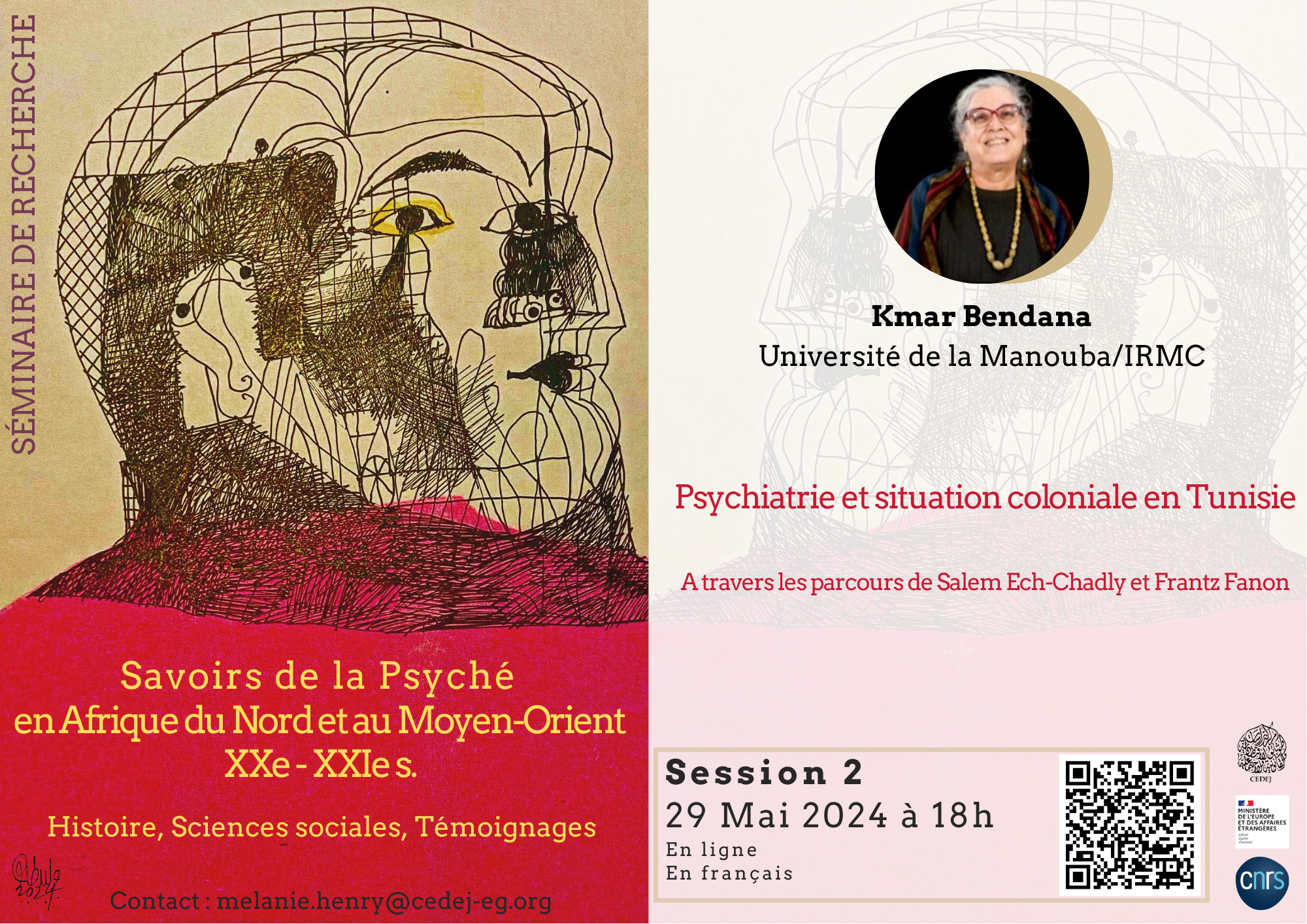
Psychiatrie et situation coloniale en Tunisie

Psychiatrie et situation coloniale en Tunisie. A travers les parcours de Salem Ech-Chadly et Frantz Fanon

Conférence de Kmar Bendana 


Date : 29 Mai, 2024Heure: 18h - 19h30 (Heure d’Egypte)

Intervenante:
Kmar Bendana est historienne, Professeure émérite à l’Université de la Manouba et chercheuse associée à l’Institut de recherche sur le Maghreb contemporain. Au fil de ses recherches sur l’histoire intellectuelle et culturelle de la Tunisie contemporaine, elle a embrassé de nombreux thèmes et objets : magazines, cinéma, universités, institutions culturelles,traduction, psychiatrie. Sur ce dernier sujet, Bendana a donné plusieurs conférences et écrit l’article « Sur les traces de Frantz Fanon à Tunis » dans la revue Algérie Littérature/Action en 2012. Elle a analysé en historienne la révolution de 2011 en Tunisie au fil de riches publications, à l’instar de son dernier ouvrage, Parler en historienne après 2011. On peut suivre ses travaux sur le blog “Histoire et culture dans la Tunisie contemporaine“.


Résumé

La période coloniale offre un cadre de réflexion intéressant pour observer le roisement des conditions et contraintes d’exercice du métier de psychiatre. La psychiatrie,cette « médecine de l’âme », née au milieu du XIXème siècle, se développe audébut du XXème siècle en France et en Europe. Le contexte tunisien, sous protectorat français à partir de 1881, connaît les premières retombées de l’institutionnalisation des mesures sanitaires. A partir du début du XXème siècle, la Tunisie enregistre des échos de cette spécialité médicale qui se nourrit des progrès des études psychologiques, de l’invention de la psychanalyse puis d’une diffusion des idées et des connaissances sur l’inconscient, les pathologies de comportement, le traitement des maladies mentales. A travers le parcours de deux médecins, considérés comme des pionniers de la psychiatrie en Tunisie, je propose de restituer la façon dont chacun s’est comporté, en son temps, comme médecin psychiatre en situation coloniale et a vécu les liens de domination qu’elle engendre.
Salem Ech-Chadly, (1896-1954) est un Tunisien nationaliste qui fait des études de médecine en France puis se spécialise pour devenir « médecin aliéniste ». Frantz Fanon, (1925-1961) est un médecin français ayant pris la nationalité algérienne et devenu membre du FLN algérien. Il a séjourné et travaillé en Tunisie de 1957 à 1961. L’un et l’autre ont exercé au sein d’une institution hospitalière créée en 1924 sous le label : Hôpital des maladies mentales de La Manouba et chacun a fait face, à sa manière, aux pratiques de la psychiatrie coloniale.

Inscription en ligne:
https://cnrs.zoom.us/meeting/register/tJcrcuGhrT0tGNWcO6Gt5qtCq1wiPy1u4I8G?fbclid=IwAR1oqp-0imJmVGKrIcgTUG80020iAw-UydX5uBFWKIAdylC2gsSCcK4Px38#/registration